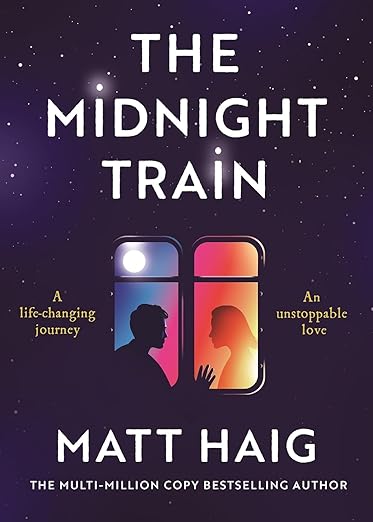
Matt Haig was born in Sheffield, England. His novels include The Humans, How to Stop Time, and The Midnight Library, which has been a number one New York Times bestseller and sold more than fourteen million copies world-wide. His non-fiction works include his award-winning mental illness memoir Reasons to Stay Alive and The Comfort Book. His latest book, The Midnight Train, was published in 2026.
Wilbur Budd, a retired bookseller, dies of a heart attack at age eighty-one, moments after receiving a surprise phone call from his ex-wife Maggie and reading an old letter she wrote when leaving him decades earlier.
Following his death Wilbur finds himself aboard the Midnight Train. He embarks on a magical train journey that allows him to revisit key moments of his life – from the childhood trauma that shaped him to the relentless ambition that cost him his greatest love. Wilbur finds it unsettling to reflect on his choices.
The Midnight Train offers us an inventory of life lessons. Like Wilbur, we discover that our choices have consequences that extend beyond the grave, that shape our eternity.
Letting your heart break:
‘Sometimes you have to let your heart break in order to stay alive.’
Author Parker J. Palmer says, ‘There is no way to be human without having one’s heart broken.’
The heart can be broken in a myriad of ways. Often, it has to do with loss – the death of a loved one, the failure of a relationship, the collapse of a financial investment, the end of a career.
Some people try to avoid heartbreak by choosing a risk averse life, living in the shadows, evading public scrutiny. Fear of loss and uncertainty are what drive risk aversion and the hidden resolve to play it safe. A risk averse life shuns situations we cannot control.
To live fully is to accept risk. Even when our intentions are honourable, things may not turn out the way we expect. There may be failure and disappointment. But character is shaped by adversity. Faith and courage grow strong during challenging times.
Heartbreak is not to be avoided. It softens us, allowing us to engage with a range of emotions. It can be an abundant source of compassion and grace.
Falling in love with books:
‘Wilbur is an avid reader because stories give him room to grow beyond the world he inhabits. They help him feel as if the lives he reads about are intertwined with his own, like threads in an ever-expanding rope. Stories make him strong.’
Reading broadens our minds and expands our horizons. The more we read, the better we can build up and expand our knowledge. Reading introduces us to diverse characters, allowing us to see the world from viewpoints that differ from our own.
Reading is a powerful tool for enhancing communication skills and emotional intelligence. As we read various narratives and meet different characters, we gain insights into human emotions, motivations, and relationships.
Reading is one of the best ways to foster imagination. We are introduced to the latest ideas and are encouraged to understand new things.
Ruth Gaskovski, a homeschool mother of three, says,
‘To read a book is to commune with the mind of an author, and when you read a good one, you leave more human when you turn the last page.’
Feeling the hurt:
‘Maggie’s face flinched just a little, as if some of his pain had splintered and shot through the air just by saying it. She was then and always as incapable of hiding emotions on her face as a river was able to hide the ripples from a fallen stone.
She was always that person. The one who was just in tune. The one who knew that life was easier if you cared about people. She just made life more natural.’
Maggie is sensitive to the hurt in others. She feels their pain. She is compassionate, loving, present. As her marriage to Wilbur begins to unravel, she feels powerless. There are entrenched feelings of anger, regret, and failure that are driving him to be something unreachable and she feels excluded, neglected, and forgotten. She no longer matters to the person she loves most.
The word ‘compassion’ originates from the Latin word compati, meaning to see the suffering of others and take action to stop it. The world is crying out for people of compassion, people like the Good Samaritan who felt compelled to do something, to get involved.
Author Frederick Buechner describes what it means to have compassion in this way:
‘Compassion is sometimes the fatal capacity for feeling what it is like to live inside somebody else’s skin. It is the knowledge that there can never really be any peace and joy for me until there is peace and joy finally for you too.’
Striving for success:
‘Wilbur saw how much he had been shaped and conducted by his youth. The striving for a success he thought he needed to justify his existence. And the struggle with a love he didn’t think he deserved.
Work gave him meaning and he had loved it. But work – to the excesses he had done it – was also a way to live without living. A way to transfer emotions over to something less personal, something with lower stakes.’
Wilbur creates an empire, Budd Books. What starts as a single bookshop in Sheffield becomes his life, his obsession. He allows himself to believe that success will ‘justify his existence,’ and ‘make him worthy of Maggie’s love.’ His restless striving eventually costs him everything: his marriage, his close friends, his sense of self.
Wilbur thought that to succeed in life you just had to keep spinning. Like a sycamore seed on the wind. And that the faster you span the further you would reach. That, provided you kept accelerating, you could outrun scarcity, outrun your past, outrun your nightmares.
Although success is often portrayed as the key to happiness, this is not always the case. In pursuit of what we think we want we can lose what we truly value.
C. S. Lewis says,
‘Don’t let your happiness depend on something you may lose.’
Defined by tragedy:
‘The tragedy was like a magnet. Even then, right at the start. It pulled everything into its field. And that is how it stayed, throughout Wilbur’s life.’
Wilbur’s background is complicated. His father died in WWII, and his mother was left to raise his older brother, Dougie, and Wilbur. She had no help and no money, and it proved extremely challenging for everyone.
Wilbur’s train journey takes him back to that dreaded night, July 27,1964. At a Rolling Stones concert, a resentful Dougie, drunk after learning of Wilbur’s scholarship to Oxford, instigates a fight. When attacked, Dougie pulls a knife, forcing the brothers to flee in a high-speed car chase with the police. In a moment of panic, Dougie swerves to avoid a rabbit, crashing the car into a sycamore tree and dying instantly.
Wilbur feels responsible for Dougie’s death. He shouldn’t have talked about Oxford, he shouldn’t have allowed Dougie to drive so fast, he shouldn’t have mentioned the rabbit. Dougie’s tragic death casts a shadow over Wilber’s life. The grief is constant. The anger, the guilt, the sadness are always there, influencing who he becomes, and there is no escape. He masks his feelings with constant work and ambition.
Reflecting on his brother’s death, Wilbur begins to see that ‘the existence of tragedy in your life does not mean your whole life has to be that way.’
Running away from sadness has not served him well. That is how he shrunk a life while pretending to expand it. That is how he became a failure pretending it was a success.
Eyes wide open:
‘This world is full of folk who look but never see. I am looked at a hundred times a day. But not many see. Thanks for seeing, lad. Keep that, lad. Stay seeing…’
As a young man Wilbur befriends a homeless war veteran. Perhaps the connection has something to do with the loss of his father during WWII. They would talk, and if Wilbur had money in his pocket, he would share it.
There is a universal need to be seen, to be noticed. It is not something we can control. When it happens, it feels right, affirming our humanity and confirming we belong.
There are people in shopping malls, nursing homes, and public places waiting to be seen, waiting to be authenticated, waiting to be included, just waiting. We hear the veteran’s words,
‘Thanks for seeing, lad. Keep that, lad. Stay seeing…’
Love is eternal:
‘The thing with love is that it can feel so eternal that it can be mistaken for something that will be around for ever. Like a rock formation. Or the sky. But love is like every other human thing – it withers without attention.’
Love is like a garden. It requires constant attention. Loving another person requires vigilance and perseverance. It is a lifelong commitment.
Love is also fragile. It can struggle to maintain its vibrancy. It can die on the vine.
Maggie left Wilbur because she felt starved of his love. To understand what it feels like to be denied love it is helpful to think in terms of opposites.
What is the opposite of love? Some people believe the opposite of love is hate. But there is nothing to suggest that Wilbur hated Maggie. Other people say apathy. Apathy means we no longer care; we have lost interest. Wilbur cared for Maggie, but his busy schedule precluded him from showing it. The opposite of love, as far as Wilbur is concerned, is pointless ambition. Having a global chain of bookshops isn’t going to cut it for Maggie.
God’s love exceeds human love. It is constant, ever-present, and real. There is no escaping God’s love, whether we acknowledge it or not. His love is eternal.


