Miriam Toews was raised in the Mennonite town of Steinbach, Manitoba, where religious doctrine governed daily life and individual expression was often suppressed. The Mennonite emphasis on pacifism, simplicity, and separation from the world created a nurturing yet stifling environment, where questions about faith or personal desires were met with silence or disapproval.
Miriam Toews was the second daughter of devout parents—her father a teacher and her mother a homemaker. Her father, Melvin, struggled with bipolar disorder, a mental health condition that causes extreme mood swings. Mental illness was a subject rarely talked about in their community. The cultural taboo around mental health shaped Toews’ outlook on the world.
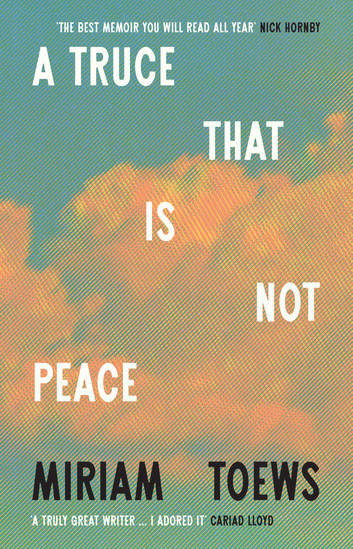
Writing was how Toews expressed what she had internalised for so long. In her memoir, A Truce That Is Not Peace (2025), she not only candidly explores the tragedies that visited her family – the deaths by suicide of her father in 1998 and her sister Marjorie (or M as she calls her) in 2010 but also reflects on why she writes.
The title of her memoir comes from Christian Wyman’s ‘The Limit,’ an essay in his book Ambition and Survival: Becoming a Poet (2007) Wyman is an American poet who was diagnosed with a rare incurable blood cancer twenty years ago. He writes,
‘For those of us who have gone to war with our own minds there is yet hope for what Freud called ‘normal unhappiness,’ wherein we might remember the dead without being haunted by them, give to our lives a coherence that is not ‘closure,’ and learn to live with our memories, our families, and ourselves amid a truce that is not peace.’
Wyman suggests that the death of someone we love need not completely overwhelm us. We can continue to think about them generously, constructively; we do not need to feel constrained to resolve every issue, every ambiguity; we can accommodate our thoughts and memories, however awkward or distressing, into our daily existence.
The word ‘truce’ has several meanings: ‘the suspension of fighting’ or ‘respite from a disagreeable or painful state.’ Wyman’s use of this word suggests that at some point we need to give our minds a rest. The constant questioning and analysis can wear us down and rob us of the possibility of experiencing joy. Wyman is eager to remind us,
‘Joy can occur in the midst of great suffering.’
The tragedy of suicide raises a myriad of questions, many of which remain hidden, unresolved. Both Toews father and her sister punctuated their lives with ‘long periods of silence.’ Medical professionals ruled out a genetic link. One question weighed heavily: Why did her father and sister choose to be silent?
When Toews was born her father fell silent for the first year of her life. She says,
‘When my father did not speak for an entire year, the first year of my life, he would walk and walk and walk until his feet bled and his long body collapsed next to my tiny one on the living room floor. He would look at me and wonder: Who is this?’
What was her father dealing with, what was he feeling, what drove him to such extremes – anger, frustration, disappointment, fear, confusion, unworthiness, inadequacy, estrangement?
His descent into darkness began suddenly, without warning. Toews says,
‘My father had a heart attack at school, in the classroom, his favourite place, a world where he made sense to himself, a world bustling with excited eleven-year-olds, a few weeks before Christmas while standing on a ladder hanging elaborate decorations, lights, mistletoe, celebrating the miracle of the birth of a saviour, his saviour.’
Her father never returned to the classroom. He was unable to continue in the role that gave him meaning and purpose and made him feel alive. The lights had gone out. His body survived another few years and then he was gone. His final words to his daughter were delivered with a touch of humour. He said,
‘Did you have much trouble deciding what to wear?’
Toews had worn the same torn jeans and green hoodie every day for the two weeks leading up to his death.
In 1982, at the age of eighteen, Toews set out for Europe in the company of boyfriend, Wolfie. Her sister M asked her to write. They made a deal: ‘You live. And I will write.’ Toews often says that the letters to her sister, honest reflections laced with humour, and adventure, and the absurd, were the start of her writing life.
Her sister M had a traumatic past. She was attacked by a carful of young men and drenched in rancid brown liquid. Her emotional wounds ran deep.
At the age of twenty-four she left university, left her boyfriend, left the city, and moved back home with her parents. She stayed in her old bedroom most of the time, making lists, reading poetry, sleeping, wearing a green terry cloth housecoat…
It was during her late teens that M went silent for the first time. From that point on there were intermittent periods of non-speaking. Toews struggled to understand why her sister would choose to be silent. She says,
‘My sister’s silence was a creative act – or was it? Had her suffering destroyed her language, or faith in language, and left her unable or unwilling to speak? Or was her silence a creative choice, an act of creation, an effort? Or was it language, or its futility, its shortcomings, that destroyed her first.’
All silence is language.
Was her sister’s silence a holding on to something vital, a way of protecting herself, her plans, her future? Toews says,
‘In that silence was she holding on to something tightly with every muscle, every bit of energy, her soul, her self?’
Was her sister fearful, fearful of causing pain, fearful of being challenged, or misunderstood or rejected? Or this,
‘Does her silence hold the perfect expression of her suffering?’
Toews didn’t understand her sister’s silence. It annoyed her, disturbed her.
She asked her mother why her father and her sister went silent. Her mother replied,
‘It was something they could control.’
People who are suicidal feel their life is spinning out of control, that the ground beneath them is constantly shifting. They have nothing to hold on to, nothing to inspire confidence, nothing to provide reassurance. Their struggle is personal, interior, of their making.
A therapist friend suggested to Toews that there is an element of impulsivity to suicide. Toews rejected this proposition. Neither her father nor her sister acted impulsively. She says,
‘They spent their lives planning their deaths, living their deaths, almost dying every day, dying almost every day.’
Toews can see similarities between writing and silence. Both are solitary endeavours, driven by a need to understand, to communicate, to preserve, to survive. There is a powerful desire to create something that is believable, that confronts the difficult questions and looks to find a translation for the unexplainable. Writing and silence have the potential to succeed or fail. Toews says,
‘Silence and writing are, if not quite the same thing, then allies.’
One thing is certain: you will never write well if you cannot be silent.
Writing is life. Silence is how we deepen our appreciation of life. Silence provides the space for the words to take shape. Silence opens new vistas of possibility. Silence is the place of incubation.
A Truce That Is Not Peace is a gritty book, disturbing, challenging, and yet gently softened by incidental anecdotes of humour and grace.
The book touches on many of the themes that were present in my book Adam: God’s Creation released earlier this year. My book is available in PDF format on this website in the Resources section.
- ‘Waring with our own minds’
You do not have to be suicidal to be at war with your own mind. It suggests a flood of opposing thoughts that resist cataloguing, that crash into each other causing mental distress. An agitated mind knows no peace.
Our son Adam was unable to resolve the conflict in his mind. His constant thoughts denied him rest. They propelled him toward a certain end.
- Her father was ‘unable to continue in the role that gave him meaning and purpose.’
The devastating impact of illness can rob a person of meaning and purpose. Suddenly, they lack a reason to live.
Our son Adam could find no cure for his fractured self. His hopes and dreams lay shattered. He could see no way forward.
- ‘Joy can occur in the midst of great suffering.’
We do not have to be dictated to by our circumstances. A tragedy may bring intense sadness, but it is the small acts of kindness that fill us with joy.
Our son Adam lost his appetite for joy. He could no longer see the beauty and wonder in life. He found consolation in knowing that he could end it all.
- ‘The tragedy of suicide raises a myriad of questions.’
Why live? Why die? Is suicide both death and survival? Why did they do it, my father and my sister? Does suicide end the pain and preserve the truth? Is suicide incomprehensible?
Our son Adam had an unwell mind, a disturbed mind. Suicide offered a solution to the ‘psychological pain.’ How do I know? The truth is, I don’t. I don’t know why our son chose to end his life. The questions never go away.
- ‘There is an element of impulsivity to suicide.’
Overdosing on drugs; jumping off a cliff; discharging a rifle; driving the Ute into a tree. You could argue that each of these actions requires little planning, a choice driven by opportunity… a bottle of pills in the bathroom cabinet.
Most people who die by suicide have wrestled with thoughts of ending their life. Toews father and sister both entertained their end. Their lives took a downward spiral. Those near to them could see they were losing their grip on life. Toews wrote to her sister,
Dear M,
I don’t know what to do. I have a terrible feeling about things, a terrible feeling… I love you. Love is very important – it is the only comfort. I wish I could take your sadness away.
Our son Adam denied having suicidal thoughts. His diaries told another story. He talked about the end of his life, of being no more. We do not know whether Adam chose the site of his death or whether he discovered it by accident. The CCTV footage that captured the moment clearly suggests a quiet resolve rather than impulsivity.
- ‘In that silence she was holding on to something tightly.’
Toews sister was dedicated to silence. She returned to it again and again. Silence minimises the distractions, controls the input. Silence is self-preservation, building a fortress, protecting that thought. Silence creates space to process the contradictions, to bury the disappointments, and to address lasting conflict.
Our son Adam talked sparingly. There were aspects of his life that he shielded from us, there were tensions he never tried to explain. Silence is solitary. It was a place where Adam could plan a future, however convoluted, however sparse.


