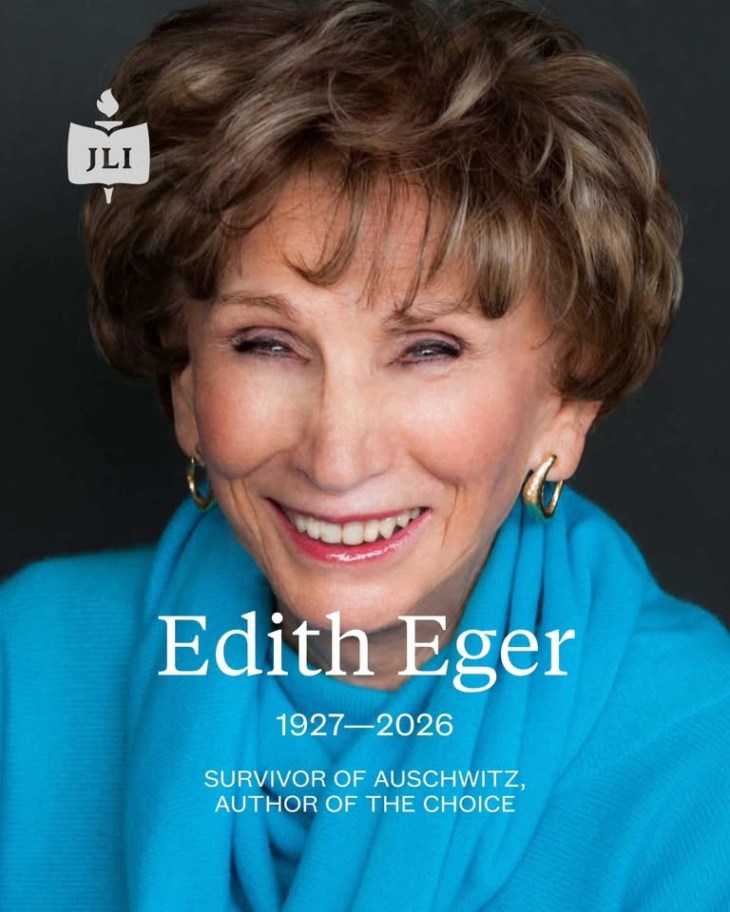
Edith Eva Eger (née Elefant) was born in Košice, Czechoslovakia, later Hungary, on Sept. 29, 1927. Her father, Lajos, was a dress designer. Her mother, Ilona (Klein), had worked for the foreign ministry and was a gifted cook.
Edith (she preferred Edie) was the youngest of three sisters. Klara and Magda were talented musicians. Klara was a violin prodigy. Magda, her older sister, accompanied her on piano when they performed around Europe.
[Image: Courtesy of the Rohr Jewish Learning Institute]
Edith was an accomplished ballet dancer and had set her sights on becoming an Olympian in gymnastics, a dream she never realised because she was Jewish.
In 1944 Edith Eger, aged sixteen, was transported to Auschwitz. Her parents and her sister Magda travelled with her in the infamous cattle cars. Klara avoided the ignominy as she was studying at the conservatory in Budapest. The conditions were appalling. Her mother, Ilona, sensing what awaited them, encouraged Edith with these words.
‘Just remember, everything can be taken away from you. What you put here in your head, no one can.’
This profound thought provided Edith with the key to surviving Auschwitz. No matter how harsh your circumstances, no matter what suffering you endure, no matter the horrors you witness, no one has control of your thoughts. The narrative you create in your mind will help you survive.
On arrival, Edith was parted from her parents who were sent to the gas chambers. The smoke from the chimney stacks signalled their end. Edith and Magda were stripped and had their heads shaved.
That night, the sadistic Nazi officer Dr. Josef Mengele, forced Edith to dance for his amusement and her survival.
The orchestra began to play ‘The Blue Danube.’ Edith pondered what her mother had said and took flight in her thoughts. She imagined herself at the Budapest Concert Hall dancing Romeo and Juliet.
Edith spent six months in Auschwitz, toiling, starving, avoiding death, and looking for moments of life. She was struck with a dog leash when she snuck out to the latrine and had to give blood several times a week to feed the German war effort.
In the final months of the war, Edith and Magda had to endure the endless death marches. When they arrived in Mauthausen concentration camp, they saw piles of corpses, skulls, pools of blood. The walking continued unabated. They eventually arrived in Gunskirchen, Austria.
American GIs liberated Gunskirchen on May 4, 1945, a few days after Edith and Magda had arrived. A young soldier noticed Edith lying amongst a pile of dead bodies. He quickly summoned medical help.
On her return to Kosice, where sister Klara resided, Edith saw a doctor who diagnosed her with a fractured back, typhoid fever, pleurisy, and pneumonia.
After the war Edith married Bella (Albert) Eger, the grandson of a wealthy food wholesaler. The couple settled in Presov where their daughter Marianne was born.
But their stability was short-lived. In 1949, Communist authorities confiscated the family business and arrested Albert.
On his release, the young family fled first to Vienna and then to the United States. They settled in Baltimore. Two more children came, Audrey and John, an further blessing to their family.
Dr. Eger earned a bachelor’s degree in psychology in 1969 and her PhD in psychology in 1978, writing a thesis on how some children who experience trauma grow up to thrive. She saw herself in the people she studied and treated.
Dr. Eger became an eminent psychologist working with people struggling to overcome traumatic events in their lives – from violent relationships and child sexual abuse to post-traumatic stress disorder and addiction.
[Biographical information courtesy of Julie Gruenbaum Fax, content strategist and writer for the USC Shoah Foundation]
Nobel Peace Prize Laureate, Desmond Tutu, provides this fitting tribute:
‘Dr. Eger’s life reveals our capacity to transcend even the greatest of horrors and to use that suffering for the benefit of others. She has found true freedom and forgiveness and shows us how we can as well.’
Having experienced trauma in my own life, I wanted to learn what Dr. Eger had discovered about surviving trauma and thriving as a person.
Both Dr. Eger’s best-selling books, ‘The Choice’ and ‘The Gift’ were published after her 90th birthday.
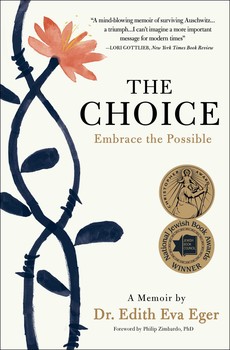
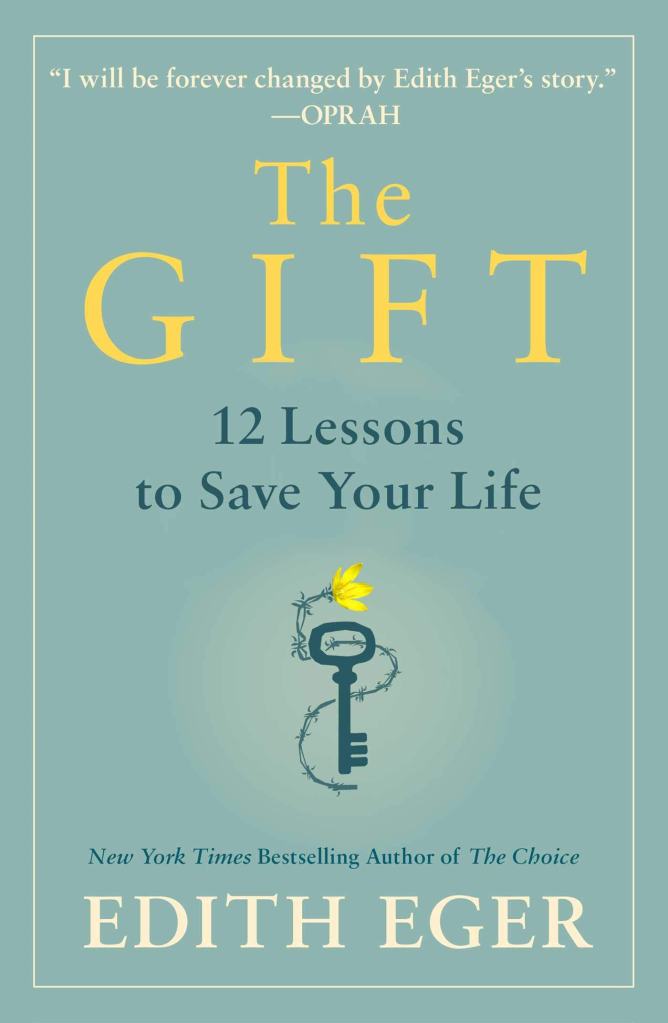
I read Dr. Eger’s memoir The Choice in November 2017. The book powerfully illustrates her decades-long journey to not only survive but also transcend the atrocities of the Holocaust or the Shoah as Jewish people refer to that time. The Choice teaches a profound lesson: healing from darkness is a lifelong process.
You will find a sample of the many important quotes from The Choice and The Gift in My Book Notes:
The Choice – https://hopefortomorrow.info/wp-content/uploads/2022/08/my-book-notes-the-gift-edith-eger.docx
The Gift – https://hopefortomorrow.info/wp-content/uploads/2022/08/my-book-notes-the-gift-edith-eger.docx
I have received help from her comments on the following subjects:
Mind:
Her mother’s words are worthy of further consideration. She said,
‘No one can take away from you what you put in your own mind.’
We may not be able to control what is happening externally, but we can guard our thoughts. We can protect our interior life. We can choose our attitude. We can assume responsibility for who we become. We do not have to surrender to the darkness. Dr. Eger says,
‘If you change your thinking, you can change your life.’
The biggest prison is in your mind. If we stay bitter and resentful about what has happened, it will teach us nothing. If we can find a reason to be grateful, a light is switched on allowing us to see how we have been changed for the better. Our focus is now on how we can support others.

Attitude:
Dr. Eger appreciated the writing of Viktor Frankl. He says,
‘Everything can be taken from man but one thing: the last of the human freedoms – to choose one’s attitude in any given set of circumstances, to choose one’s own way.’
Each moment is a choice. No matter how frustrating or boring or constraining or painful or oppressive our experience, we can always choose how we respond.

Life is difficult. It is not what happens to you that is important; it is what you do with what happens to you. Dr Eger says,
‘You are not what happened to you. You are what you choose to become.’
We cannot change the past. We cannot draw a live under it and pretend it didn’t happen. We cannot hide the scars. But we do not have to allow the past to dictate who we are.
Victimhood:
Dr. Eger insists there is a difference between victimisation and victimhood.
Victimisation, she says, comes from the outside – some kind of affliction, or calamity, or abuse, caused by circumstances or people or institutions over which we have little or no control.
Victimhood comes from the inside. No one can make you a victim but you. We develop a victim’s mind – rigid, blaming, pessimistic, unforgiving, punitive…
A good definition of a victim is when you keep the focus outside yourself, when you look outside yourself for someone to blame for your present circumstances, or to determine your purpose, fate, or worth.
Often when things go wrong our default position is to blame God. Many prisoners in the death camps thought this way.
Dr. Eger thought differently. She says,
‘It is not God who is killing us in gas chambers, in ditches, on cliff sides, on 186 white stairs. God does not run the death camps. People do. If I am to be close to God now, I want to keep alive the part of me that feels wonder, that wonders, until the very end.’
We remain a victim as long as we hold another person responsible for our own well-being. Dr. Eger says,
‘I was victimised, but I am not a victim; I was hurt but I am not broken; the soul never dies, meaning and purpose can come from deep in the heart of what hurts us the most.’
Forgiveness:
Dr. Eger spent decades wrestling with ‘survivor guilt,’ (feeling guilty for surviving the traumatic events when others died, for not being able to rescue them). She was determined to stay silent and hide from the past. She says,
‘How easily a life can become a litany of guilt and regret, a song that keeps echoing with the same chorus, with the inability to forgive ourselves.’
Thirty-five years after the war ended, Dr. Eger returned to Auschwitz. She says,
‘I wasn’t free until I returned to the lion’s den and looked the lion in the face. I reclaimed my innocence and assigned the shame and guilt to the perpetrators.’
Dr. Eger forgave herself for surviving. Forgiveness gave her freedom. She says,
‘There is no freedom in minimising what happened, or in trying to forget. But remembering and honouring are very different from remaining stuck in guilt, shame, anger, resentment, or fear about the past.’
Memory:
Our memories are not catalogued. Some memories are multi-faceted. Some aspects may make us feel proud while others cause regret; some may confirm how much we were loved while others speak of hate. Dr. Eger says,
‘To remember is to concede to the horror again and again. But in the past is the love that I felt and sang in my mind all those months that I starved.’
When we remember, we force ourselves to ask the uncomfortable questions, the unanswerable questions. Dr. Eger says,
‘Memory is sacred ground. But it is haunted too. It is the place where my rage and guilt and grief go circling like hungry birds scavenging the same old bones. It is the place where I go searching for the answer to the unanswerable question: why did I survive?’
Memories are not to be discarded. They live on inside us, warning us, instructing us, nurturing us. They provide us with the wisdom to navigate every threat to our being and the motivation to fully live, to freely give and forgive. Dr. Eger says,
‘I have not overcome anything. Every beating, bombing, and selection line, every death, every column of smoke pushing skyward, every moment of terror when I thought it was the end – these live on in me, in my memories, in my nightmares. The past is not gone. It is not transcended or excised. It lives on in me. But so does the perspective it has afforded me: that I lived to see liberation because I kept hope alive in my heart. That I lived to see freedom because I learned to forgive.’
Survival:
Edith soon realised she wouldn’t be able to survive Auschwitz on her own. She says,
‘Survival is a matter of interdependence; survival is not possible alone.’
Edith needed Magda, she needed friends, young people who were in this with her, who were experiencing what she was experiencing, who understood the deprivation, the suffering, who were committed to each other, who were intent on survival. She says,
‘To survive is to transcend your own needs and commit yourself to someone or something outside yourself.’
They realised that to survive they needed to conjure an inner world, a haven, even when their eyes were open. She says,
‘We were able to discover an inner strength we could draw on – a way to talk to ourselves that helped us feel free inside, that kept us grounded in our own morality, that gave us foundation and assurance even when the external forces sought to control and obliterate us. “I’m good! I’m innocent! Somehow, something good will come of this. If I survive today, tomorrow I will be free.”
Hope:
Dr. Eger offers a wisdom that is carved out of rock and shaped by reality. She says,
‘Hope does not obscure or whitewash reality. Hope tells us that life is full of darkness and suffering – and yet if we survive today, tomorrow we will be free.’
Her message to people struggling against insurmountable odds is ‘If you survive today, tomorrow you will be free.’
When Edith walked out of Auschwitz, she was no longer the finely tuned athlete of another time but a ‘walking skeleton.’ The agile gymnast had been reduced by the darkness but not overcome.
Reflecting on her past, Dr. Eger says,
‘Hope isn’t a distraction from darkness. Hope is a confrontation with darkness.’
Hope isn’t passive. Hope takes up the fight. Hope looks the enemy in the eye and is not intimidated. Hope walks on, one step at a time, drawing on the strength that the ‘Giver of hope’ freely gives.
Her work and her life experience taught Dr. Eger that
‘Hope allows us to live in the present instead of the past, and to unlock the doors of our mental prisons.’
Many of us are imprisoned by the past – the anger, the fear, the regret, the sorrow, the sense of failure – but hope firmly grounded in God alone breaks every chain, releases us from every bondage, and allows us to step into freedom.


