There is joy for a parent in seeing a child take their first steps. The initial tentativeness gives way to a growing confidence. The look on the child’s face is one of surprise, excitement, and determination. The ability to walk is liberating, freeing them to explore, to investigate, to discover.
Learning to walk has an element of risk. There are stumbles and falls, scrapes and bruises. Nothing is gained without struggle and persistence. The unknown is there to be conquered and walking makes it possible.
Walking has its origins in God. The biblical account of creation and the fall describes God walking in the garden in the cool of the evening. Our ability to walk is God-given.
Walking has so much to offer us. When we choose not to walk, we lose our way, our equilibrium, our purpose. Not walking is not living. This is not the case for people who are unable to walk. Their focus, like ours, is to make the best use of what is at their disposal.
Our lives are increasingly fast paced. Walking helps us to slow down, giving us time to think, to breathe, to notice.
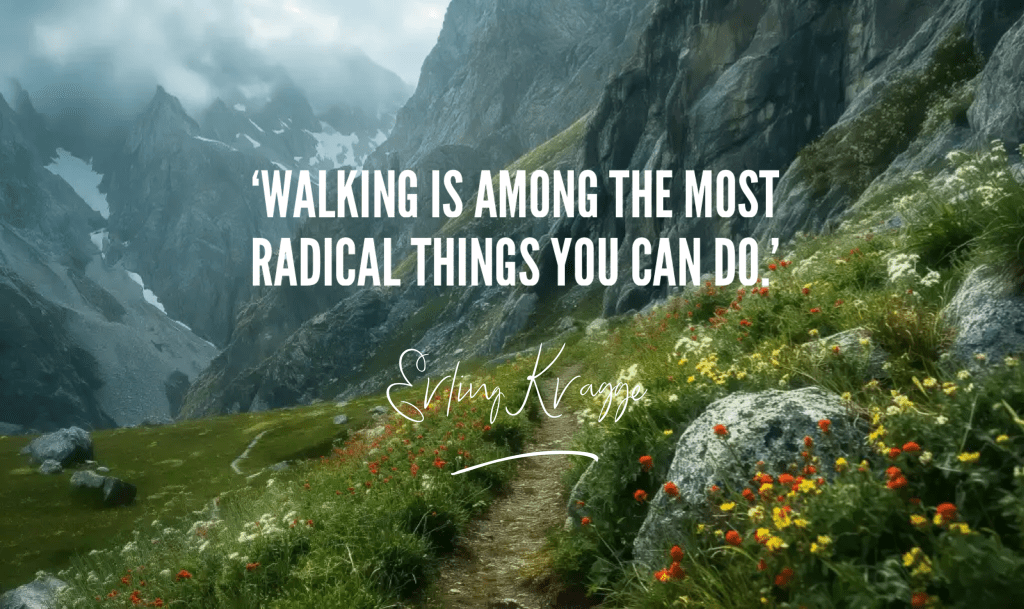
In his book, ‘Walking: One Step at a Time,’ Erling Kragge says,
‘Walking is among the most radical things you can do.’
Walking requires effort and tests our endurance. A brisk walk increases our heart rate, fills our lungs, and utilises the large muscle groups in our body like our arms and legs.
Walking challenges us. It asks that we press on even when the path before us is long and arduous.
The philosopher Martin Heidegger says that we should be willing to burden ourselves to be free. If we always choose the path of least resistance, we become averse to anything that would challenge us.
Understanding the benefits of walking increases our desire to walk. But not all walking is the same.
Everyday Walking:
Everyday walking is expressive. We stagger to the bathroom, shuffle to the fridge, trudge to front door, tiptoe up the stairs, trip over the cat, trample on the kid’s toys, waddle out to the letter box, and stalk the cockroach that has disappeared behind the cupboard door.
Everyday walking is functional. It gets us going. It is useful, allowing us to complete mundane tasks. Life would be more problematic without it.
Everyday walking is preparatory. It is a start, promising so much more. We need to get out of the house, to expose ourselves to the simple pleasures of life. To look up, to breathe in, to stride with purpose. Plan a walk to a destination fifteen minutes away, such as a coffee shop, a friend’s house or a grocery store and then walk back home.
Inspirational Walking:
Researchers suggest that,
‘Those that require a fresh perspective, or new ideas, would benefit from going for a walk.’
Walking magnifies receptiveness. It clears the mind, dispensing with all that is outdated or irrelevant.
Walking allows us time to play with ideas, explore concepts, and wrestle with our random thoughts.
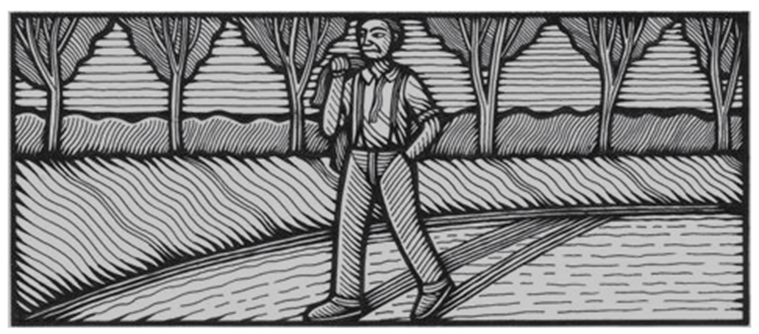
To the German philosopher, Fredrick Nietzsche, walking out of doors was the invariable accompaniment to his writing. It was where he worked best.
When he wrote, The Wanderer and His Shadow, he walked, alone, for up to eight hours a day. Nietzsche would stop to scribble notes in small notebooks with a pencil. The entire book, except for a few lines, was thought out and composed en route.
William Wordsworth was an English Romantic poet. Both his parents died before he was fifteen years of age. As a young man Wordsworth developed a love of nature. He made walking central to his life and art to a degree almost unparalleled before or since. He seems to have gone walking every day of his long life (175 to 180,000 English miles). Walking was both how he encountered the world and how he composed his poetry.
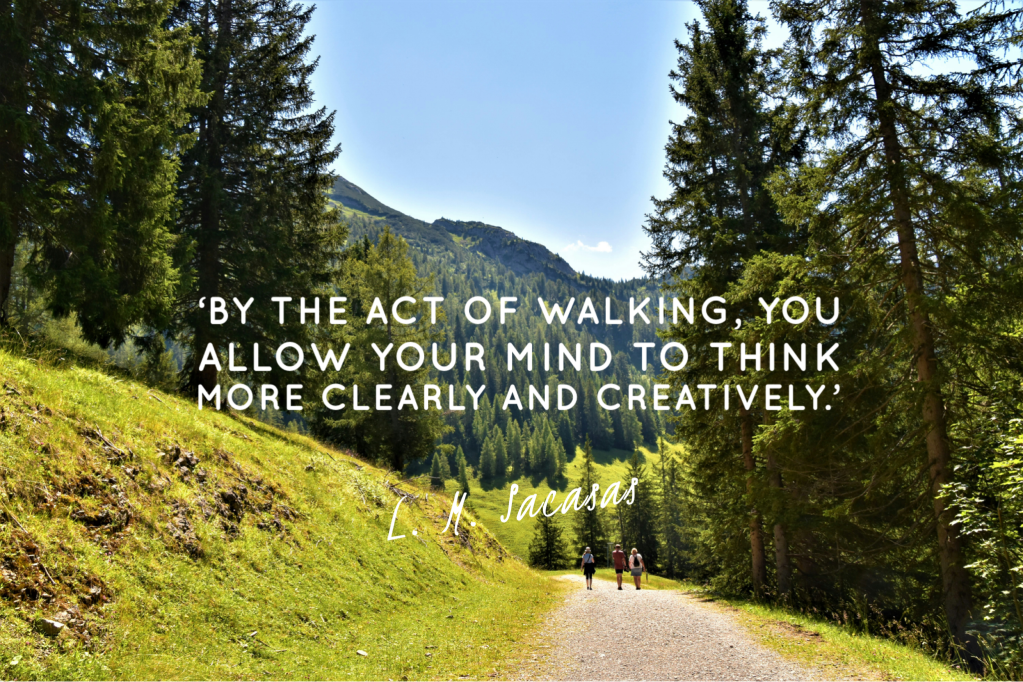
L. M. Sacasas suggests,
‘By the act of walking, you allow your mind to think more clearly and creatively.’
Grief Walking:
Grief walking is intentional. Rather than hiding from your grief or dismissing it entirely, grief walking offers an opportunity to engage with it, to listen to its heartbeat.
Following Adam’s death, I discovered grief walking. The benefits were incalculable.
Grief walking invites connection. It is an opportunity to draw near to your loved one, to be at peace with your loved one.
‘I feel compelled to walk. The emotional turmoil threatens my sanity. I need to find a way to address it. The rhythm of walking calms the soul. The forward movement, one step at a time, rebuilds confidence, restores hope.
I wear an item of clothing that belongs to Adam, a jumper, a jacket. It draws me closer, assuring me of his presence, a different presence, something I carry within me.
I received a gift of a hand cross. I carry it in my pocket. I think of Jesus, nailed to the cross. His cross, a symbol of brokenness. It speaks to me of Adam, his broken body, his broken spirit.
My walk takes me along residential streets, through parkland, by a golf course. I find any loud noise, the screech of tyres, a dog barking, distressing. It heightens my unease, my anxiety. It takes time for the calm to return.
The high point of the walk provides a vista of the outskirts of town. In the foreground, a cemetery. Many of the tombstones show signs of neglect, leaning to one side, or lying abandoned on the ground. I am reminded of our mortality, that death awaits us all. I ponder my son, Adam, jogging to his death.
In the distance is the steeple of a church. It is the church we attend. There is a cross, raised up, crowning the steeple. I hear the words of the Angel, ‘He is not here. He is risen.’ The resurrection of Jesus is our hope, our only hope. It allows me to boldly declare, ‘O death, where is your sting?’’
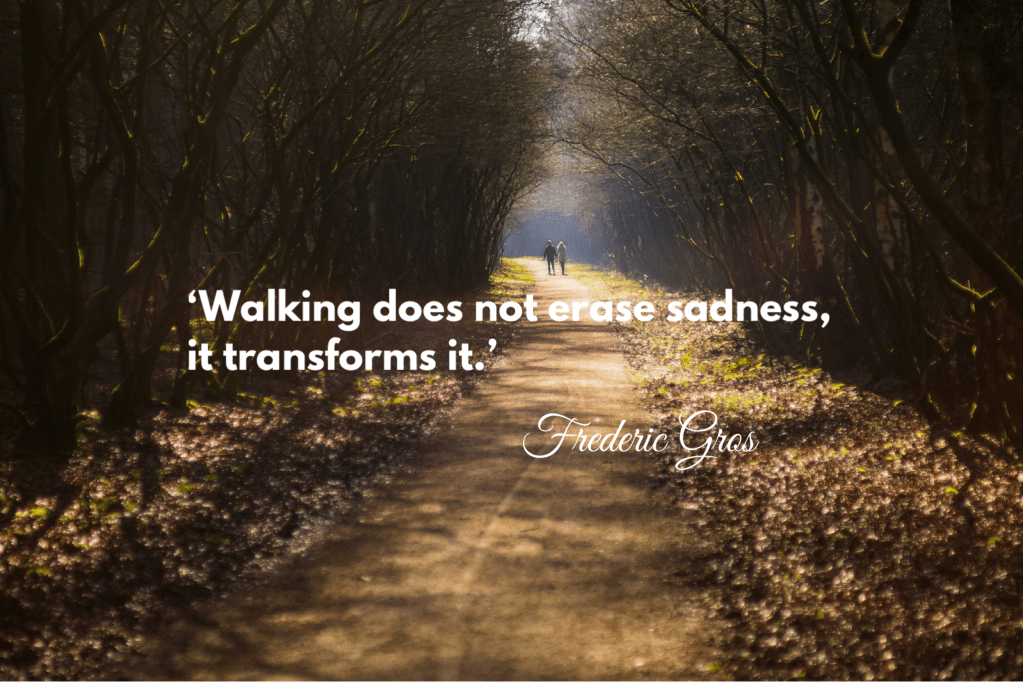
In his book, A Philosophy of Walking, Frederic Gros says,
‘Walking does not erase sadness, it transforms it.’
Prayer Walking:
Walking holds the power of repetition, one foot in front of the other. That power of repetition is found elsewhere, in a certain form of prayer called the Jesus Prayer or the ‘prayer of the heart.’
The classical form of the Jesus Prayer is,
‘Lord Jesus Christ, Son of God, have mercy on me, a sinner.’
The history of the Jesus Prayer goes back to the early sixth century, with Diadochos, who taught that repetition of the prayer leads to inner stillness.
The shortened version of the Jesus Prayer, ‘Lord, have mercy, Christ, have mercy,’ is suitable for prayer walking.
I have used two applications of the Jesus Prayer when walking.
First application:
1st step 2nd step 3rd step 4th step 1st step 2nd step 3rd step 4th step
Lord, have mer… cy, Christ, have mer… cy.
Second application:
1st step 2nd step 3rd step 4th step 1st step 2nd step
Lord, have mer… cy,
3rd step 4th step 1st step 2nd step 3rd step 4th step
Christ, have mer… cy.
The Jesus Prayer is for everyone. It is a simple prayer that is easily committed to memory. God wants us all to pray. The Jesus Prayer allows that to happen. It links our walking with our praying.
The Jesus Prayer is useful in time of extreme concern or upset, when you feel overwhelmed and are desperate to know you are not alone. God is present, and He cares for us. The words of the prayer capture our need and point to someone who is both Lord and Christ.
When we prayer the Jesus Prayer we are affirming that JESUS is both Lord and Christ. When we refer to Jesus as ‘Lord,’ we are recognising his authority over all things. When we use the title ‘Christ,’ we are declaring that Jesus alone has the power to save, to set free.
The term ’mercy’ reflects our dependence on God. We are acknowledging our need of His healing love and forgiveness.
When we repeat the Jesus Prayer all restlessness, agitation, and concern is corralled. We experience an ‘inner stillness.’ When our hearts and minds are quiet, we are open to God and attentive to what He has to say.
Praying the Jesus Prayer requires persistence. It is so easy to become distracted or discouraged. Pay attention to your thoughts. Acknowledge what they reveal. Write down what needs further consideration. Start over. Persevere. Walk on.
Contemplative Walking:
Contemplative walking requires silence. Distractions need to be eliminated. If you are planning to walk with a friend, agree not to chatter. Chatter makes contemplation impossible. As one writer expressed it,
‘Chatter deafens: it turns everything into nonsense, intoxicates you, makes you lose your head. It is always there on all sides, overflowing, running everywhere, in all directions.’
Contemplation is defined as ‘thoughtful observation.’ It requires attentiveness to your surroundings. It is being alert to the unexpected. It is being awake to the subtle changes, changes in movement, in light, in perspective. Contemplation asks that we pay attention, that we focus on what is before us. It does not matter where you are walking, be it a rural or urban environment. It comes down to what takes your interest and how that speaks to you.
In March 2017 I wrote a blog post, ‘Dead Trees Talking.’ It begins,
‘It is a curious thing. As I walk along the Bendigo Creek Trail, I become fixated on the dead trees. They are not clumped together, like monuments in a cemetery, but interspersed among the living. Their gnarled skeletons are framed by a backdrop of green. An unexpected thought presents itself, ‘What if dead trees could talk?’’
I imagine that if dead trees could talk, they would say,
‘Expect adversity:
It will shape your identity
and define your future.’
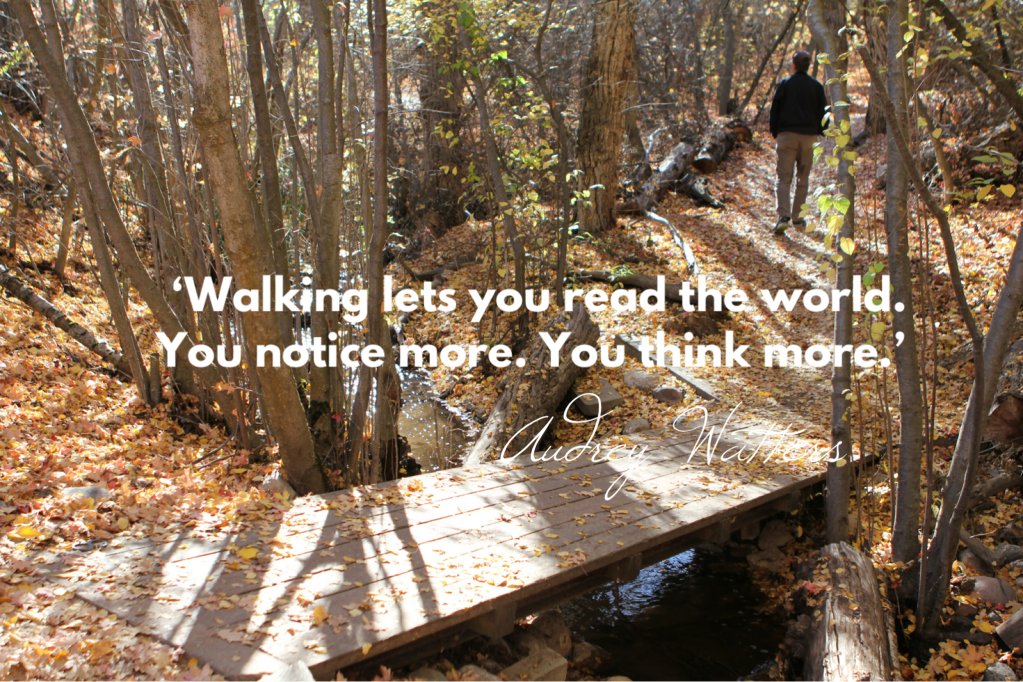
Audrey Watters says,
‘Walking lets you read the world… the pace with which one moves through the world while walking allows for a different, deliberate kind of seeing. You notice more. You think more.’

 Hope For Tomorrow
Loved that Daddio,
I remember when we lived in Hastings and would walk to the bookshop together (or I would walk to my supermarket job?) you taught me the walking prayer and I’ve always remembered it and say it most days, especially when I’m nervous or feel a panic attack coming on.
I also remember you teaching me to be fully present t when doing mundane things like washing the dishes, a type of meditation.
You are a wise soul aren’t you!! 😘
Have a lovely weekend xoxo
Sent from my iPhone
LikeLike