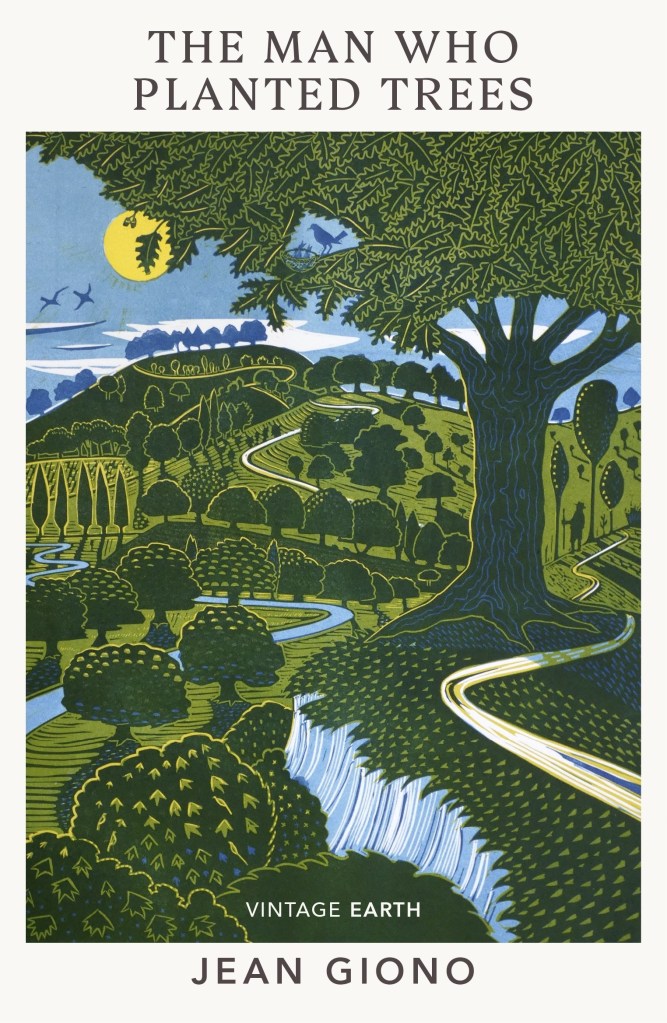
‘The Man Who Planted Trees’ by Jean Giono was published in 1953. Giono was one of France’s greatest writers. He wrote more than 30 novels, many of which have been translated into English. Giono was a pacifist. He was imprisoned twice in France at the outset and conclusion of World War II.
In his article on Giono’s writing and his interest in ecology, Olivier Serrat says,
‘Giono’s outlook was shaped by his harrowing experiences during the Great War (1914-1918). Drafted at the onset of the conflict, he was thrust into the attritional Battle of Verdun (February-December 1916) – grimly known as La Fournaise (The Furnace). The apocalyptic confrontation wrought unspeakable devastation – its once-fertile landscapes reduced by relentless artillery fire to scarred, cratered terrain – claiming more than 710,000 French and German lives in less than a year. The carnage Giono witnessed forged his lifelong commitment to pacifism, permeating his work with themes of hope, ecological balance, and the enduring power of renewal.’
‘The Man Who Planted Trees’ is a short, allegorical story about a shepherd named Elzéard Bouffier who lives in a desolate valley in the French Alps. It is a barren expanse, extreme conditions for a shepherd and his small flock of sheep.
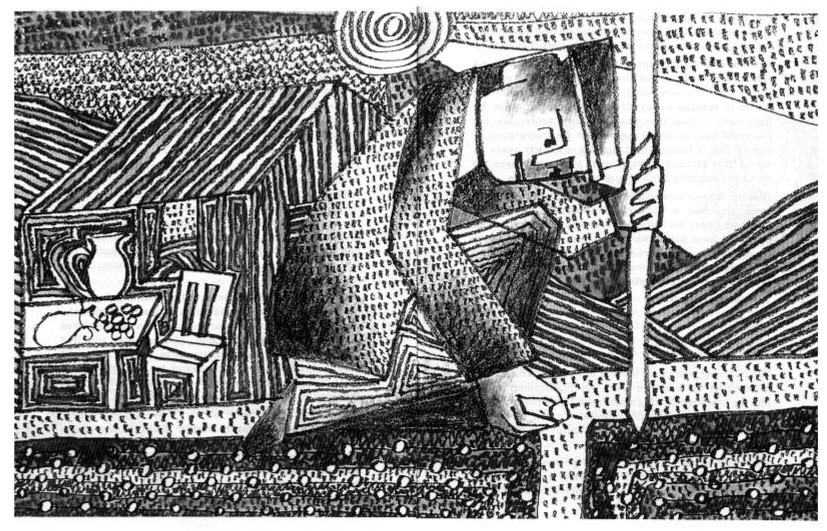
Elzéard lives a solitary existence. It is one he finds to his liking. When a visitor arrives, he offers him water and invites him to stay the night. Elzéard has little to say. His evening routine involves sorting seeds. He is planting a forest of oak trees. He separates the good seeds from those that are small or slightly cracked and sets aside the ones he plans to use in packets of 10, up to 100.
Raju Deshpande
The visitor appreciates Elzéard’s hospitality and wonders at the veracity of his vision, the transformation of the desert into a place of vibrancy and beauty. Over the following years he returns regularly, to reconnect with his friend and witness the rebirth, the flourishing of the trees and the recovery of a sustainable environment.
Restoration is a powerful word. It means to bring back to life, to heal what is broken, to rebuild what has been torn down. Restoration is God’s work. God is saddened by all that has been lost, abandoned, damaged, or neglected. He wants us to work with Him to ‘restore all things.’
The world is replete with examples of things needing restoration like aspects of the natural world, our government institutions, our societal values, our family relationships, our monetary systems, our church communities, and so on.
Elzéard Bouffier is an example of a person who committed their life to the principle of restoration. His life reflects what is needed for any work of restoration.
Awareness:
Awareness is the ability to see, to understand, and to appreciate what action is required. It is immersing yourself in the situation and allowing it to speak to you. For those of you with an interest in the Bible and what it has to say, consider Nehemiah who felt burdened by the broken-down walls of Jerusalem. He conducted his inspection under the cover of darkness so that he would not be seen. (Nehemiah 2)
Elzéard Bouffier sought solitude following the death of his only son and then his wife. He took pleasure in living slowly, with his flock of sheep and his dog. Elzéard reminds us that slow living is a positive way of responding to your grief. Slow living allowed him to see his sadness mirrored in the desolation of the landscape.
The two key issues presented themselves to Elzéard. They were land degradation and population decline. He appreciated their interconnectedness. Fix one and the benefits would flow outward.
Land degradation: The harsh, barren landscape suggests to him that the country is dying. Considered, thoughtful, and targeted intervention – this is what is needed. Elzéard cares enough to get involved and address the problem.
Population decline: The dwindling resident population is dispersed throughout the region. There are a few remaining woodcutters working in groves of white oak. They make charcoal and transport it to the cities in trucks. Life is harsh and the weather extreme. The relentless wind is constant and rattles the nerves. There are suicides and bouts of madness in the wider community.
Vision:
The Bible reminds us that ‘without a vision the people perish.’ (Proverbs 29) Vision relates to commitment and purpose. Vision gives meaning to life. It inspires and invigorates. If you are not committed to something you are not committed to anything. That makes for a very shallow existence.
Elzéard can see what no one else can see, the potential for arid land to flourish. He realises that this could be done through planting trees, thousands of trees.
Whatever the vision it is important to communicate it simply and succinctly. I started the ‘Hope for Tomorrow’ website over ten years ago. The catalyst was my son’s death by suicide in 2011. I felt a responsibility to share what I was living and learning. I wanted to tell people that you can find hope even when life feels broken, that you can feel positive about tomorrow even when the future appears dark and dismal.
Elzéard’s vision is to ‘Restore the Land.’ His time and energy are given freely to this end.
Faith:
Faith is dynamic, an active force – determined, rigorous, and confident. Faith is both qualitative and quantitative. Jesus commended faith wherever he saw it. He said to his followers that if you have ‘faith like a grain of mustard seed,’ you will be able to move mountains. (Matthew 17:20) Faith is the doorway to miracles. A little faith goes a long way.
Faith is irrepressible, it cannot be held down or locked away. Self-obsessed people have no room in their lives for faith for faith looks beyond our selfish interests.
Faith is vital for any work of restoration. Faith is built on the fact that we are not enough. It is God who brings our work to fruition. He takes pleasure in exceeding our expectations.
Elzéard uses an iron rod to make a hole in the ground. He drops a seed into the hole and covers it over with soil. When asked by the visitor, he explains that he has planted one hundred thousand trees over the past three years. Elzéard sows liberally, knowing that many seeds will not survive. He explains,
‘Of the hundred thousand, twenty thousand sprouted. Of the twenty thousand half would be lost to rodents or to the unpredictable designs of Providence. Still there remained ten thousand oak trees to grow where nothing had grown before.’
Faith is not about mathematical equations, it is about outcomes, it is about transformation. Faith focusses on the harvest, what is achieved. Incremental change is worth celebrating. Remember, faith is a force that generates its own momentum.
Discipline:
Discipline is perseverance. Without perseverance you won’t stay the course. Discipline is an ordered life, having a regular routine. Establishing daily habits allows us to achieve realistic goals.
Discipline calls for sacrifice, the letting go of anything that would stand in the way of realising your vision. Discipline asks the question, ‘What will it take?’ It is the willingness to embrace the daily grind of turning up and doing what needs to be done.
Every work of restoration can be broken down into parts. Discipline welcomes each part, appreciating where each part fits into the plan.
A disciplined life looks to enhance understanding and knowledge. Elzéard studied the reproduction of beech trees. He created a nursery near his cottage and built a wire fence to keep the sheep out. He also considered birch trees which he thought would grow well in the valleys where moisture is present below the surface.
A disciplined life embraces change that will bring about a better outcome. Elzéard got rid of most of his sheep as they threatened the young trees. Instead, he invested in a hundred beehives to help with pollination.
Elzéard continued his work into his late eighties until his health began to falter, and he was admitted to a hospice.
Rebirth:
When Elzéard’s friend returned to the area after The Great War he didn’t know what to expect. He had seen so much misery and devastation. What greeted him was a miracle of rebirth, ‘a work worthy of God.’ The trees were flourishing – the oaks formed a vast forest, beech trees spread out as far as the eye could see, and handsome clumps of birch were thriving in the valleys. It was as though creation had been re-awakened, and the birds and animals were drawn into the revitalised landscape.
The countryside was changed in other ways as well. Streams which had been dry flowed once more; people returned to the villages and rebuilt where there had been piles of rubble. There was a vibe of life and optimism.
Any work of restoration feels like a rebirth, a starting over, a new beginning. It is something to behold, to rejoice in.
Opposition:
There were setbacks. One year, Elzéard planted more than ten thousand maple saplings. All died. But he was not the sort of person to became anxious or depressed. Disappointments were unavoidable. He could always try other varieties of trees.
The Forestry Commission were alerted to the changing landscape. A delegation visited the forests to assess their health and decide on a management plan. They were impressed and were ‘captivated by the beauty of those young trees in the fullness of health.’ They referred to it as a ‘natural forest.’ Elzéard found this amusing. He had never heard of a forest growing out of its own accord. The only helpful thing to come out of their visit was that the whole forest was placed under the protection of the State and charcoal burning prohibited. The forestry representatives begrudgingly accepted that Elzéard knew more about forestry than they did.
The only danger to the work occurred during the war of 1939. As cars were being run on gazogenes (wood burning generators), there was never enough wood. Cutting was started among the oaks of 1910, but the area was so far from any railroads that the enterprise turned out to be financially unsound and was abandoned.
Hope:
It is easy to forget that Elzéard Bouffier is a fictional character. But he is such an inspiration. Like many of us, he hoped that his sacrificial acts of service might produce fruit. His love of planting trees transformed a barren landscape. Our love can be transformational too.
Hope sustained him, hope in a Creator God. He knew that by aligning his work with the purposes of God he would triumph. He never doubted. His patient, dedicated efforts brought their reward. His unassuming life proved a blessing to many. He triumphed where others would have given up. He made a difference, and so can we. If nothing else, PLANT A TREE.

 Hope For Tomorrow
I envy anyone with that much dedication to one goal. Thanks for sharing your valuable thoughts.
LikeLike