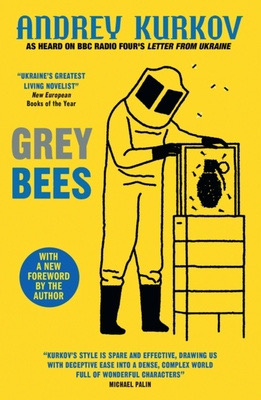
Ukraine’s most famous novelist, Andrey Kurkov, has given us Grey Bees, a story that highlights the struggle of a thoughtful and sensitive man, Sergey Sergeyich, and his determination to survive in a time of conflict and uncertainty.
Sergey Sergeyich is a 49-year-old retired safety inspector who suffers from Silicosis. He lives in the village of Little Starhorodivka in Eastern Ukraine’s Grey Zone, the no-man’s-land between loyalist and separatist forces.
Most of the inhabitants of the villages and towns in the Grey Zone left at the very start of the conflict, abandoning their flats and houses, their orchards and farms. Fear was the major reason for their departure. Kurkov writes,
‘Everyone else in Little Starhorodivka had wanted to leave when the fighting began. And so, they left – because they feared for their lives more than they feared for their property, and that stronger fear had won out.’
Some fled to Russia, others moved to the peaceful part of Ukraine, and others still joined the separatists. Sergeyich and his wife Vitalina are no longer together. Vitalina and daughter Angelica live in Vinnytsia, a place they visited frequently.
Sergeyich has a neighbour in the next street. Pashka is what you might call a ‘frenemy.’ Sergeyich has never liked him, even though they went to the same school. The current situation has forced them to modify their opinions of one another and try to get on.
In their village, there are no shops, no police station, no power, no TV, no telephone, and no postal deliveries unless the warring parties agree to a ceasefire.
The story is a meditation on life. It suggests that we all go through tough times when life feels grey, when all the colour has seeped out of our existence. Times that reflect feelings of being under threat, compromised, or defeated.
Sergeyich’s life is a testimony to how we can survive in the Grey Zone.
Find a purpose:
Sergeyich has a clearly defined purpose. He is a devoted beekeeper. His sense of responsibility toward his bees tempers his fears, allowing him to function despite the danger. His working life in the mines taught him resilience, preparing him for the challenges he meets.
Sergeyich lives for his bees. Their survival is dependent on him being there, employing his knowledge, care, and diligence. He has six beehives. During the winter months, he keeps the hives in a shed, sheltered from the extreme conditions. A felt lining covers the inside of each hive while the exterior has sheets of metal.
No matter how dire our circumstances, we all need a purpose. When our life lacks direction, it ceases to have meaning, leaving us feeling empty, despondent, and perplexed. Without a purpose there is confusion and indecision resulting in impaired mental health. Anxiety and depression are common symptoms in those whose lives have stagnated.
British Prime Minister Winston Churchill provided decisive leadership throughout World War II. He said,
‘It is not enough to have lived. We should be determined to live for something.’
Welcome the silence:
Despite the extreme conditions making daily life challenging, Sergeyich maintains an interior quiet. By filtering the different noises that enter his consciousness he redefines the silence. This ability encourages a peaceful existence. We read,
‘Sergeyich’s silence was not unlike the silence of others. It easily absorbed the drone of an aeroplane up in the sky or the night-time chirp of a cricket that had hopped through an open window. All quiet sounds that cause no irritation and don’t turn one’s head eventually fuse into silence. So it was with Sergeyich’s peacetime silence. And so it became with his wartime silence, in which military sounds suppressed and displaced peaceful, natural ones, but, in due course, also nestled under the wings of silence and ceased to draw attention to themselves.’
We live in a noisy world, polluted by sound. Most noise is not of our own making. It is present in the environment, and it is unregulated.
Researchers conclude that excessive and prolonged noise can have a harmful effect on our health. Regular exposure to loud noise can cause hearing loss. It can also ramp up our stress levels.
We need to be intentional in our quest for quiet. Where possible, ‘Say no to noise!’ Like Sergeyich, we need to learn how to filter out noise, to reduce our sensitivity to its intrusive qualities, to find an inner silence.
Some noise, however, has therapeutic qualities. Natural sounds like the wind, and the rain, and the buzzing of bees bring reassurance and comfort. They are a restive quiet, calming our restlessness and anxiety. As Sarah Clarkson says,
‘The gifts of quiet are nothing if not a return to what is essential, what is elemental within us.’
Simplify your Life:
Sergeyich must make do with the limited resources that are available. The winter months pose a serious challenge. He survives on a diet of buckwheat, millet, and the occasional egg, heating his home with a coal-fired potbelly stove and lighting it with candles scavenged from the ruins of the village’s bombed-out church. He discovers,
‘When you live without something long enough, you find it no longer has a hold on you.’

On occasions, when his supplies run low, Sergeyich walks to Svitle under the cover of darkness. The journey of 3 kilometres requires caution as there are deep craters in the road and the occasional unexploded shell.
Sergeyich visits old Nastasya. He discovers she has power to her property. There is a light globe in her dining area and the TV is on. Sergeyich is mesmerised by the pictures he sees. He thinks to himself,
‘Perhaps life is more peaceful without the images of suffering and loss.’
Nastasya offers him a bowl of borscht which triggers memories from the past, bringing tears to his eyes. After eating, Sergeyich exchanges his honey for eggs, a can or two of stewed pork, and a bottle of pickled cucumbers.
Sergeyich lives an ordered life. He has an alarm clock which occupies a place of honour in the middle of his table. He is careful to keep it wound up. Time provides structure to his day, a reference point, a connection to the past, to what is familiar. There is a rhythm to time that honours his daily rituals. Kurkov writes,
‘It was usually Sergeyich’s feet, not his thoughts, that would bring him out to the edge of the garden. He would often wander through the yard, surveying his property. First, he would peek into the shed, to check on the bees, then into the ramshackle garage, to check on his old green Lada estate. Then he would walk over to his heap of long-flame coal, which grew smaller every night but still gave him confidence in a heated tomorrow and day after tomorrow. Sometimes his feet might bring him to the orchard, and then he would pause by the hibernating apple and apricot trees. And sometimes, though less often, he would find himself on the very edge of the garden…’
Be principled:
During times of struggle and adversity it is difficult to hold onto our beliefs, to preserve what is right and honourable.
Sergeyich is an orthodox believer with a strong faith in God. He accepts the divine origins of humanity. He affirms the dignity and ultimate worth of every human being.
When Sergeyich looks out on the snow-covered fields he notices a black spot. It unnerves him. He is certain it wasn’t there the last time he looked. He asks Pashka if he can borrow his binoculars. On further inspection, he concludes the black spot is a body lying on its side. His conscience tells him he cannot ignore this reality. As the light fades Sergeyich makes his way across the snow-clad field. He is aware that he is a prime target for any would be sniper so adopts an army crawl.
Sergeyich can find no identification on the body. Nearby, there is a blue backpack that contains bags of sweets – cold as ice. Sergeyich gets to work using his sapper shovel to cut out squares of frozen earth which he places over the body. It is difficult, exhausting work but will offer the dead man some protection from the gaze of strangers, as well as from hungry ravens.
Having returned home, Sergeyich looks at the backpack and empties the contents on the table. He remembers the children in Svitle who talked of ‘Santa Claus’ giving them sweets and promising to return. Even though the darkness has settled, Sergeyich feels compelled to go back to the neighbouring village and deliver the tokens of goodwill. It is the least he can do, and in a small way honour the man with the kind heart who didn’t deserve to die.
Show compassion:
In her book ‘Atlas of the Heart’ Brene Brown describes compassion as ‘the daily practice of recognising and accepting our shared humanity so that we treat ourselves and others with loving-kindness and we take action in the face of suffering.’ Sergeyich understands that compassion is not just a feeling. It is doing.
As spring approaches, Sergeyich knows he must take his bees far from the Grey Zone so they can collect their pollen in peace. He decides to set off for Crimea not only to find a safe outing for his bees but also to find Akhtem, a Crimean Tatar who was Sergeyich’s roommate at a beekeepers’ conference twenty-five years earlier.
Sergeyich drives the Lada with the trailer attached. It is a slow journey due to the weight of the beehives and the various checkpoints. Establishing your identity is paramount so having a passport and the correct documentation is essential. There are nervous moments when he is taken to interview rooms and questioned about his living arrangements, who he knows, and what his intentions are.
When Sergeyich arrives at the address provided by his friend Akhtem he discovers that he disappeared two years ago. The Cossacks grabbed him. He hasn’t been seen since. Despite not knowing any of the family, they allow him to place his beehives next to Akhtem’s. The location is ideal: a beautiful, quiet spot with mountains and trees and a river. Sergeyich can breathe easy. He says,
‘The air in Crimea is like butter tea: you can breathe it, drink it, even eat it.’
Sergeyich develops a respectful relationship with Akhtem’s family. Aisylu, his wife, asks him if he could try and find out what happened to Akhtem. This is a difficult assignment and fills Sergeyich with fear, ‘a strange inexplicable fear, purely physical, paralysing his facial muscles.’
The Crimean Tatars have suffered a lot in the previous decades at the hands of the Russians. To be advocating for them could jeopardise his welcome and compromise his safety. Nonetheless, he approaches the Federal Security Police or F.S.B. He is told to be careful what he asks. Several days later a body is returned to Aisylu. Her husband had been killed and buried in the forest.
The Tatar community are under constant harassment by the Russian authorities. When Bekar, the son is taken into custody for a minor infringement, Aisylu asks Sergeyich if he might be able to help Aisha, her daughter, relocate to Ukraine to continue her education. Sergeyich wonders whether Vitalina might be able to assist. To his surprise she agrees to help, providing a place to stay until Aisha is settled. Although there are more details to sort out, they have a plan.
Remove the threat:
How do we discern a threat? Often they are things that find a way into our life without our consent. We need to be discerning as to who we trust. Motivation is a murky area. We don’t always see how people want to interfere in our lives, to influence our choices.
Sergeyich is sitting by the fire when a minibus makes its way up the incline. The two officials explain that they are confiscating one of the hives to run some tests. Sergeyich worries that they might fabricate a reason to destroy all the hives.
Several days later the minibus returns and unloads the hive. No verdict is given. Sergeyich checks the hive. The bees are quiet and appear to have a greyish tone.
Having delivered Aisha to the railway station where she boards a train to Vinnytsia, Sergeyich begins the long drive home. He considers what the officials might have done to the hive. Have they installed some equipment to spy on him, or have they infected the bees with a virus?
There is only one course of action open to him. He will use the grenade a Ukraine soldier gave him to blow up the hive. The explosion sounded like thunder and left a ringing in his ears. There is a crater where the hive had been. He regards the destroyed hive, a necessary casualty of war.
In summary:
When you find yourself stuck in the Grey Zone – confused, despondent, afraid, broken, ashamed, overwhelmed – adopt the following guidelines to help you survive.
- Find your God-given purpose: Ask God to confirm what He wants you to do.
- Desire interior silence: Take time out to be still, to reflect, to meditate.
- Simplify your life: Avoid the excesses and extravagances of modern day living.
- Be principled: Know what is good and honourable and allow your convictions to shape the way you live.
- Show compassion: Make a habit of performing acts of kindness.
- Remove the threat: Erase from your life anything and everything that undermines your confidence and destroys your hope.

 Hope For Tomorrow