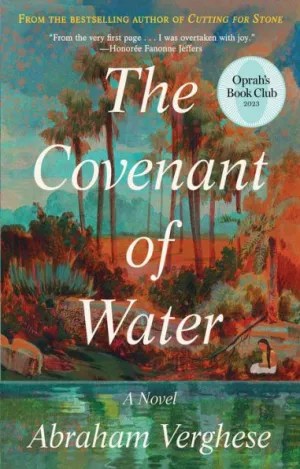
Spanning the years 1900 to 1977, The Covenant of Water, by acclaimed author, Abraham Verghese, is set in Kerala, on South India’s Malabar Coast. The story is a multi-generational tale, following the travails of a family who are part of the minority Christian community, often marginalised by the dominant Hindu culture.
Church:
According to tradition, Christianity in Kerala was founded by Saint Thomas, one of the twelve disciples of Jesus, who landed on the Malabar Coast, at Malankara, in 52 CE. He is believed to have converted a few Brahmin (high-caste Hindu) families to Christianity,
Verghese writes that those first converts, Saint Thomas Christians, ‘stayed true to the faith and did not marry outside their community. Over time they grew, knitted together by their customs and their churches.’
One of the overarching themes in The Covenant of Water is faith. The faith of the Saint Thomas Christians, their unshakable devotion and commitment to Christ and his teachings, sustained them in their bleakest hours.
For Mariamma or Big Ammachi, literally ‘Big Mother,’ as she is later known, faith is central to her life, a faith she saw in her mother when navigating the uncertainties of life. Faith, Mariamma would discover, is a constant, bringing strength and consolation, inspiring hope when the darkness threatens.
Commitment:
We see evidence of Mariamma’s faith in the way she conducts herself in her marriage. It is an arranged marriage. She is a 12-year-old girl. He is a 40-year-old widower with a young son. Despite their shared fear and apprehension, the relationship grows and deepens. Appreciation and respect form the basis of their union.
Mariamma is committed to fulfilling her domestic duties, which include cooking and cleaning and establishing a productive vegetable garden. Her domain is the home while her husband spends much of his time working outdoors. Mariamma also bonds with Jo-Jo, her husband’s child, creating for him a loving environment where he receives the nurture and encouragement he needs.
Mariamma is hesitant, not wanting to upset her husband, but she misses the support of her church family. She is uncertain how to raise this matter with him without causing a rift. It does not help that he is often tired and uncommunicative. Her prayer reveals the depth of her understanding and speaks to the nature of her relationship with God. We read,
‘No prayers, no words will come to her mouth. Does God not feel her disappointment? Eventually she says, ‘Lord, I am not going to keep asking. You see the obstacles in my path. If you want me in church, then you must help. That is all I will say. Amen’
Mariamma understands that being a Christian requires involving God in every aspect of her life. It is personal. It is looking to God to make a way when there appears to be no way. It is reminding God of your reliance on him in all things.
Her husband, Big Appachen, warms to her request. He is gratified by her industry, and her generosity in caring for his son. He offers to go with her to the church service while declining to take part in the proceedings. He still mourns the loss of his first wife.
Mariamma finds strength in the solidarity of so many worshippers, all bearing their own troubles.
Community:
As Mariamma (who we will now refer to as Big Ammachi) settles into her role as the matriarch of the Parambil Estate, a 500-acre tract of land, she is committed to creating strong relationships. She is mindful of the importance of building connections with her neighbours, of recognising their gifts and abilities, of appreciating what they bring to her family.
Big Ammachi and her husband have a daughter who they call Baby Mol (Baby Girl). Although the diagnosis comes later Baby Mol is born with a developmental disability. She will keep a childlike disposition throughout her life. Husband and wife treasure their little girl and delight in her cheerful personality. Big Appachen places the child on his hairy chest where she rests contentedly. Big Ammachi is convinced ‘A daughter has an open door into a father’s heart.’
Big Ammachi’s mother is rescued from an abusive situation and is welcomed into the family. Mother and daughter rejoice, knowing that nothing will come between them. They recognise,
‘Life comes from God and life is precious precisely because it is brief. God’s gift is time. However much or however little one has of it; it comes from him.’
Big Ammachi reflects on the waterways of Kerala and how they reveal the interconnectedness of the elements of nature and the human spirit. She recalls,
‘Where the sea meets white beach, it thrusts fingers inland to intertwine with the rivers snaking down the green canopied slopes of the Ghats. It is a child’s fantasy world of rivulets and canals, a latticework of lakes and lagoons, a maze of backwaters and bottle-green lotus ponds; a vast circulatory system because, as her father used to say, all water is connected.’
This is how life is meant to be – free flowing, interconnected, a coming together, a shared purpose, moving as one.
Condition:
Like his father, the young boy Jo-Jo has an irrational dislike of water, preferring to climb trees instead. But soon, tragedy strikes. Following a storm, JoJo falls from the branch of a tree and drowns in a ditch on the property. The family is overtaken by grief. Grief is always destabilising. It shatters the calm. It uproots the strongest foundation. Big Ammachi looks to God. God alone understands the depth of her sorrow and sadness.
In the wake of the tragedy, Big Ammachi’s husband reveals a long-held family secret: members of the family suffer from a peculiar affliction, what is termed the ‘Condition.’ In each generation, at least one person dies by drowning.
Every family has its secrets. Sometimes it is the only thing that holds them together. There is a quote in the book that says,
‘Secrecy lives in the same room as loneliness.’

While not all secrets are problematic, some secrets weigh us down. It is like having a chain wrapped around our neck. They diminish us, denying us the freedom to live fully.
Some secrets build walls. They drive a wedge, separating us from those we love. We feel a sense of abandonment, charged with the responsibility of carrying the burden alone.
At first, Big Ammachi is angry at her husband for hiding this knowledge. There is conjecture that it might be a familial curse. It seems plausible, given that no other explanation has been forthcoming. But if it is a curse, there is always a cause. There is nothing in the family history to suggest cruel or irreprehensible behaviour that might lead to adverse consequences. The fact stands, members of the family, going back every generation, have drowned – drowned in the most unusual places – shallow puddles, lagoons, lakes – in a land where everybody swims.
Big Ammachi finds comfort in the thought that her husband’s family tree will preserve the memory of her stepson.
She has a second child, a son. Philipose will never have an opportunity to learn from his father. He dies soon after his birth. His grieving mother cannot escape the truth,
‘Joy never spares us from sorrow.’
Big Ammachi finds solace and sanity in her garden. It is her greatest hope that someone will someday discover the cause of, and thus the cure for, this Condition.
Covenant:
In Kerala, water is everywhere. Water is the element that ties everything together. Water is a precious commodity. Without it, life ceases to exist. It is not surprising that the populace would want to make their peace with water.
In the Bible, the word ‘covenant’ means an agreement between God and his people. Covenants define obligations and commitments, but they are different from a contract because they are relational and personal. In the following quote we see the elements that make up ‘the covenant of water.’
‘Such precious, precious water; Lord, water from our own well; this water that is our covenant with You, with this soul, with the life You granted us. We are born and baptised in this water, we grow full of pride, we sin, we are broken, we suffer, but with water we are cleansed of our transgressions, we are forgiven, and we are born again, day after day, till the end of our days.’
Water symbolises constancy. In the Book of Genesis, the Garden of Eden is the source of four tributaries. Water flows from the garden bringing life. We are born and baptised in water. Despite our failings, our doubts and fears, water offers life and renewal. Cleansed and forgiven there is the infinite possibility for growth and transformation.
Water symbolises connection. The intricate waterways of Kerala connect communities, upstream and downstream, drawing people together. Water is a force. It gives and takes life. It reminds us that we are bound together in life and death.
Mariamma is the granddaughter of Big Ammachi. They share a name, and a passion to uncover the cause of the condition. Her studies in medicine provide the ideal background to research a medical explanation for her family’s vulnerability to water.
Standing in the river she experiences the flow of the water. She realises that despite nothing ever staying the same, her connection to past generations and those in the future is assured. She is part of their story, and God loves stories.

 Hope For Tomorrow