Patti Callahan’s captivating story, ‘Once Upon a Wardrobe’ is an exploration of death and dying through the eyes of a young boy George and his devoted sister Megs. Their mentor in this quest is the author and apologist C S Lewis.
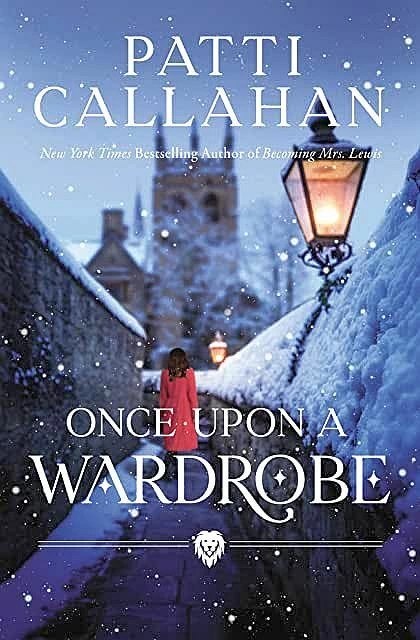
George is eight years old. He lives with his parents in Worcester, an attractive city steeped in history. George is dying. He has a weak heart. His parents feel destitute. They are bereft of ideas. They can offer their son comfort but no miracle cure.
George is often confined to bed when the weakness of his heart keeps him from getting up. At times he loses his breath so desperately that his lips turn a strange shade of blue. George’s bed is positioned near a large window so he can see outside. He appreciates the flowers his mum grows and observes how his dad’s apple tree changes with the seasons. The window is his door to the world.
George loves reading. Books are his friends. They not only keep him occupied but stimulate his mind. George says,
‘I think the world is held together by stories.’

Stories and fairy tales allow George to be another person, to escape the confines of his bed and to experience other worlds.
George is reading ‘The Lion, the Witch, and the Wardrobe’ by C S Lewis. He is captivated by the story. He senses there is something different about this book. Although it is an imaginary tale, it seems real, a timeless story for all ages and for every age.
Irish poet and philosopher, John O’Donohue once wrote,
‘A book is a path of words which takes the heart in new directions.’
George has time to think, to reflect, and to wonder. The story speaks to him, raising questions he needs to find answers to, questions that relate to the meaning of life.
George believes the author of The Lion, the Witch, and the Wardrobe will be able to unlock the background to the story, enlarging his understanding, and offer some clarity, some certainty.
George’s sister Megs is a mathematics student at Oxford University. She loves her younger brother and is willing to do anything for him to better his life. She says,
‘If I could gift George one thing in this life, other than a new heart that pumped blood to all the right places, it would be this: to give him answers to his questions about his beloved Narnia.’
George suggests she track down the university’s English literature tutor, author C S Lewis, or Jack, as he is known to his friends, and ask him, ‘Where did Narnia come from?’
Lewis is sympathetic and agrees to co-operate. He thoughtfully addresses the enquiry, sharing experiences from his own life. The stories are not what Megs anticipated but they provide George with the insight he seeks.
George wants answers to five important questions. There is a sense of urgency, given his impending death. They are questions we would do well to consider.
(1) Is this all there is?
C S Lewis was a staunch atheist. As a young boy he dismissed the idea of God. His mother died of cancer. Jack witnessed her life ebbing away. He prayed earnestly that she might recover. He couldn’t imagine life without her. He convinced himself that if she wasn’t healed then God wasn’t real.
Jack is often sick and confined to bed. On one occasion his older brother Warnie came into his bedroom with a biscuit tin lid. In it is a tiny garden made of twigs and leaves, a miniature world. We read (in Once Upon a Wardrobe),
‘Jack stared at the mossy collection and a feeling passed through him, a warmth and an opening of his heart that he could barely put into words: a yearning, a longing, a wanting…’
Lewis describes the feeling as JOY. But joy isn’t something you can hold on to. It is fleeting, a taste, a suggestion that there is more.
As George immerses himself in The Lion, the Witch, and the Wardrobe he witnesses Aslan, the great Lion, challenging the authority of the White Witch. No longer is Narnia locked into a never-ending winter. There is a thawing. Spring is coming. Joy is awakening.
(2) Is suffering meaningless?
C S Lewis knew suffering. Both he and Warnie served in the First World War. Jack was a member of the Third Battalion, Somerset Light Infantry. He recounts how ill prepared he was for war. He says,
‘When the shelling began, war was no longer an idea or a scene in a book… Fear trembled through the earth as well as my heart as I hunkered down in a muddy trench… The dissonant explosions, screams, buzzing, and pounding echoes resonated through the air.’
Jack catches trench fever; a disgusting disease caused by lice. He is sent to a hospital. It takes nineteen-year-old Jack five months to recover. When his strength returns, he finds himself back in the action.
Jack and his battalion are involved in seven days of intense fighting against the German defenses near Arras. A stray British shell killed two of his mates. Shrapnel lodges in Jack’s body: his left arm, his leg, and most dangerously, his chest. Jack discovers that war is brutal, bloody, and indiscriminate. It could have been his life that was taken.
Jack uses his experience of war in his writing, in particular, the ongoing struggle between good and evil, light and darkness. The trauma of war becomes a catalyst for good, influencing his creative endeavours. At a personal level, he is known and respected for his acts of kindness and generosity of spirit.
George is impressed by Lewis’s ability to make something beautiful out of something so horrible. He recognises the opportunity his suffering provides. He asks Megs to purchase an art book and pencils. His book becomes a catalogue of drawings of things that interest him, things that capture his imagination.
In The Lion, the Witch, and the Wardrobe, George sees the power of Aslan displayed, principally, in an act of surrender. The Lion willingly endures suffering and death at the hands of the White Witch to defeat her and diminish her influence, rescuing the inhabitants of Narnia from her treacherous rule.
(3) Is reason enough to reveal the truth?
C S Lewis sees reason and imagination existing in a collaborative, not competitive, relationship.
‘Reason,’ he says, ‘is how we get to the truth, but imagination is how we find meaning.’
Lewis uses imaginative depiction to enable readers to see a particular thing or truth more clearly.
Author Mark Neal offers this insight. He says,
‘Stories and imaginative depictions bring truths to life out of the dry-as-dust regions in which reason often strands us. This does not mean we should denigrate the truths of reason; rather, we should recognise that the imagination gives us an additional bearing on reality.’
Reason provides only half the story. Imagination makes up for the difference.
Megs has a mathematical mind. Her thought processes rely on reason and logic. But life cannot be solved like a math problem. Life is messy, unpredictable, challenging. It cannot be reduced to a formula.
George has a healthy imagination. When he listens to Megs recounting her conversations with Mr. Lewis, his mind is elsewhere. Megs explains it like this:
‘George’s imagination is taking him places while I ramble on about stories and facts about Mr. Lewis. George takes something of this world and travels to another as if the story world and the real world run alongside each other.’
For Lewis, truth is about seeing things rightly, grasping their deep interconnection. This is why George realises,
‘This man knows something.’
(4) Is there anyone there?
C S Lewis experienced loss. When his mother died, Jack knew the pain of separation. His mother brought laughter and light into his life. She helped explain the world to him. Without the warmth of her presence and the gentle wisdom of her words he wonders how he will survive.
Jack and his father have a complicated relationship. There is frustration and disappointment, and the unresolved tensions continue to simmer. It is said,
‘Loneliness is the lack of meaningful connection.’
Jack and his father struggle to connect. Jack feels that he is a disappointment to his father. He misses his mother, especially her gift of uniting the family.
During his years at Oxford Jack attracts a circle of friends, including J. R. R. Tolkien (Tollers) and Hugo Dyson. They critique his writing and challenge his thinking. Jack is still unable to accommodate God in his life but senses a vacuum, an ‘existential loneliness.’
Tollers and Dyson know of Jack’s interest in myths, the Norse myths and the Celts and the Bible. They have heard his arguments that a myth tells the truth without the facts. ‘Although the dying god who rises again is common in many traditions,’ Dyson argues, ‘Christianity is the only true myth. Jesus Christ died and rose again. It is a fact.’

This thought lodges in Jack’s mind, a myth that happened. The argument is irrefutable. Jack’s journey to belief has begun.
When George hears this story he thinks of the Lion on the Stone Table, freely offering up his life. He too, conquered the grave. And George believes he has nothing to fear.
(5) Is hope real?
George is satisfied with his life. He may not be physically strong, but he is content. Well, almost. His reading of The Lion, the Witch, and the Wardrobe has awakened in him a longing for adventure. He says,
‘I want to go somewhere. I want to have my own adventure. Everyone in the books has adventures, and I want my own.’
‘I want to see Dunluce Castle, where Jack’s mum took him on holiday before she died. I want to see the wild sea and the ruins. I want to… feel it.’

Megs doesn’t know what to say. She knows what mum and dad will think. Her friend Padraig believes this is important, the one thing they can do for George. They start making plans.
It is Christmas Day. George is back from his adventure. His father looks at all the pictures he has drawn in his notebook. Each page is a scene from Mr. Lewis’s life, and each page has a coloured lion in the background: fierce, tender, curious, or protective. He says,
‘George, it looks like you think the lion followed the author around for all of his life.’
George nods.
‘I think the lion follows all of us around. We just have to look for him.’
Hope is believing.


 Hope For Tomorrow