Our identity is often forged by experiences we would never choose – a dysfunctional family, a debilitating illness, a broken promise, an economic collapse. It is the imprint of these relationships, or events, or circumstances, which define us.
Identity is never fixed. Like a river, it bursts its banks, looking to change its direction. Identity is shaped by our economic realities, our relationships, our achievements, our health prognosis. It is these variables that determine whether we view our identity in positive or negative terms.
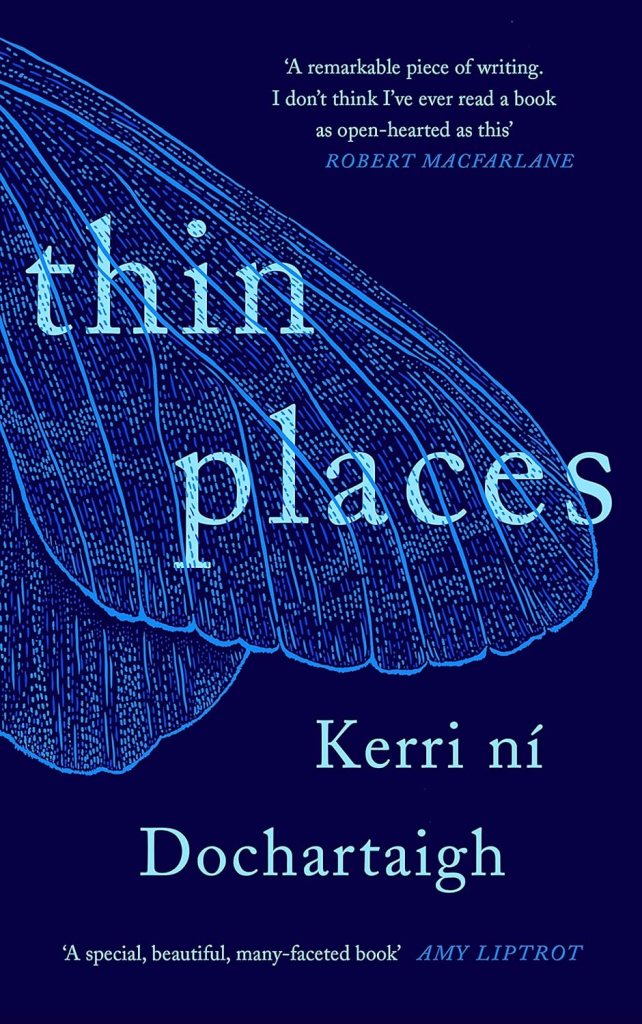
Thin Places by Kerri ní Dochartaigh is an evocative memoir, a vividly descriptive account of her war-torn childhood and her quest for peace. It is a story of survival, of overcoming personal tragedy. But to survive we need to know who we are, and that can prove a difficult and complex undertaking.
Born in 1983, Kerry ní Dochartaigh grew up in Derry, Northern Ireland, the child of a Catholic mother and Protestant father. Her parents’ religions made the family a conspicuous target during the decades-long struggle known as The Troubles.
The Troubles:
Few places in Northern Ireland escaped the violence. The uncertainty and unrest had a lasting impact, dismantling her youth and challenging her self-belief. She says,
‘Loss and violence swallowed the verges of things and watched from the corner as my childhood was eaten up.’
At 6, a British soldier is gunned down in front of her.
Aged 11, her family home in the Protestant Waterside area nearly burnt to the ground. In the night, local youths threw a homemade pipe bomb through her bedroom window.
When 16, a local boy that she had grown close to – ‘the first person to give me a Valentine’s card’ – walked her home from the chip shop, before setting off to rejoin his friends in town. He is murdered less than an hour later, his naked and bloodied body left in a shallow grave in a nearby wood.
Violence becomes the norm but even then, she knows it isn’t ‘normal.’ She says,
‘Witnessing violence of the kind we did – so often, so intimately, to such a destructive end – does something to you. You are changed for ever. Life as you know it continues, day in, day out: as unending as time, and as constant as the falling rain.’
The Trauma:
The lingering trauma of these events etched their way into her being. She says,
‘They left their shards here and there, underneath the surface and right down into the bone and the marrow.’
But because many of her neighbours had stories that were at least as disturbing, she suppressed her feelings, fearing that her ‘trauma wasn’t hard enough earned.’
The Border:
The partition of Ireland occurred in 1922. The Emerald Isle became two self-governing political entities. Northern Ireland – protestant, loyalist, unionist – remained part of the United Kingdom. Southern Ireland – catholic, republican, nationalist – became a republic.

Borders are the things unseen that keep us apart. This border, hand-drawn by man, traverses the island, driving a wedge between north and south. It divides a nation, breeding suspicion, misunderstanding jealousy, and hatred. Kerri ní Dochartaigh says,
‘This border has been the thread that has run through my life. A ghost vein on the map of my insides, it is a line that is political, physical, economical, and geographical; yet it is a line I have never once set eyes upon. This invisible line has been the cause of such sorrow and suffering, such trauma and loss.’
The Leaving:
Like many before her, Kerry ní Dochartaigh flees Northern Ireland, removing herself from the familiar and distancing herself from the past. She soon realises,
‘I may have moved away from my childhood, and from the Troubles of my home but I certainly hadn’t left any of it behind.’
She lives and works in Edinburgh, feels a deep affinity with the Isle of Mull, and travels to Iceland following the death of her grandfather.
She finds it difficult to settle, to put down roots, to trust enough to talk honestly about her past. Friends call her ‘emotionally cold.’ She recognises that the change she sought is not possible in a ‘foreign’ land. She says,
‘Sadness, trauma, and unquantifiable loss had shaped me into a person who never really allowed themselves to become rooted anywhere at all.’
The Struggle:
Kerry ní Dochartaigh withdraws into herself. She is content to internalise her hurt. She welcomes being alone. She says,
‘I would go to work, come home, and straight away close my bedroom curtains and try to pretend the world wasn’t still happening out there. If I stopped going out, seeing people, going places, then time would freeze, and I would have no more worries about my unstable, scary future.’
She dulls her pain with alcohol. Although the truth eludes her, it is the ultimate giving up, ‘giving up respect for myself, giving up any sense of belief that things might get better, giving up hope.’ She drinks every single evening. She drinks alone. She drinks to forget. The drink is a form of self-harm. The drink numbs her feelings, distorts the truth, and provides respite from the disturbing memories that harass her.
She is overcome by debilitating depression and, like many others, chooses to hide it, to suffer in deepest silence. The heightened anxiety and negative thinking erode her confidence and challenge her existence. She realises that her past is not only drastically affecting her present, but it holds the power to put an end to her future. She contemplates suicide. She says,
‘I no longer wanted to be in this world, one that I loved so dearly but that I just didn’t feel I could take any more from.’
She knows people who have died through suicide. She knows people who reached a point they could not see any way back from. She knows she stands on a precipice, looking into the dark abyss.
The Grief:
One day at work she begins to cry. Her boss asks her who has died. She is unable to find the words to adequately explain her sorrow. Her grief is complex and multi-layered, encompassing so much of her life. She says,
‘I was crying for the years of unwanted transience. I was crying for my own unbroken silence. I was crying for lost things, for things not yet lost but that I felt sure were not going to stay for much longer. I was crying for me, for so many others; I was crying for the past – for things and places – for memories, and for things that were never going to be.’
Grief is personal. It writes its own script. Once it has your attention it is wise to stay with it, to surrender to it and to learn what it can teach you. Grief is part of who we are. She says,
‘Grief is a country that has no definite borderlines and that recognises no single trajectory. It is a space that did not exist before your loss, and that will never disappear from your map, no matter how hard you rub at the charcoal lines. You are changed utterly, and your personal geography becomes yours and yours only.’
The Return:
Kerry ní Dochartaigh feels compelled, for reasons she cannot fully explain, to return to Derry, on the banks of the River Foyle. It is her birthplace, a border city with a tumultuous past. She associates her home place with fear and upheaval. And yet, her homeland is silently waiting, calling her, eager to shed light on all that is hidden, dark, and buried. She longs for release, and to find healing for her anxious heart. She says,
‘A call back to the land that made me, that wounded and broke me, the land that turned out to be the only place that held the power for me to heal.’
The Healing:
Kerry ní Dochartaigh decides she has had her fill of pain and sorrow. It is time to make peace with the past and to finally move forward.
There are three people who play an important role in her healing.
Her partner – He is a stayer, committed to the recovery process. He is not looking for excuses to walk away. He understands that this will not be an easy journey. He endeavours to be non-judgmental while believing truth should never be compromised.
Her therapist – She provides a safe environment in which Kerry ní Dochartaigh can break the silence she has carried for decades. She says,
‘I was told, over and over, by someone I trusted, that I was allowed to feel how I felt. I was allowed to share, without judgement, the way I felt about myself and others – those still here and those now lost.’
The sessions help her believe that her being here in this world matters.
Her grandfather – Although deceased, he remains a strong presence, providing stability, and connecting her to her past. She remembers him as a gifted storyteller. She says,
‘His most affecting tales, ones he gave me that shaped my life, were about place, about how we relate to it, to ourselves and to one another.’
He gifts her the term áiteanna tanaí, or ‘thin places.’ They are sacred places that straddle two worlds, bridging the gap between heaven and earth. They are places that nurture a connection with the natural world – the birds, the foxes, the moths, the butterflies, and the dragonflies. They are places that deliver moments of clarity, allowing us to know ourselves deeply. Thin places are not limited to wild and remote regions, they also occur in urban settings, in car parks and street corners. Kerry ní Dochartaigh says,
‘There are places that are so thin that we see right through it all, through the untruths we have told ourselves about who we are… We see through every bit of the things that we once thought defined us. We see that, like a landscape that has undergone vast and irreversible shifts, we, too, might be capable of change.’

 Hope For Tomorrow